Showing posts with label Jude Law. Show all posts

Saturday, March 9, 2019

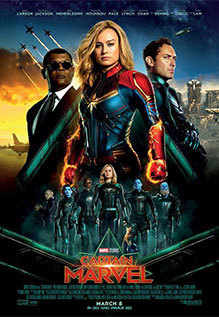
Captain Marvel (2019)


Captain Marvel (2019)

Directors: Anna Boden, Ryan Fleck

Cast: Brie Larson, Samuel L. Jackson, Jude Law, Annette Bening

Captain Marvel is an anticipated superhero film because it’s the film that connects to Avengers: Endgame (2019), the end all be all of superhero big budget films. People don’t really know who Captain Marvel is because it’s never been one of the most popular characters. No my friends,  audiences will flock to Captain Marvel because it is a Marvel film (and therefore big budget) and because of its Avengers: Endgame connections. This movies job should be to get everyone hyped for Captain Marvel and love the character by the end of the movie, so that you’ll end up wanting to go see Avengers: Endgame day one. Captain Marvel had to have a wow factor to it. Did it achieve it? Endgame will be the pinnacle of everything that Marvel Studios has been working on for the past couple of years. The ending of a series of interconnected films that always leave you on a cliffhanger wanting more! The cliffhanger comes from the comics these films are emulating. I know because I’ve always collected comics since I was a kid and still do. The comics I read back in the 80’s and 90’s, were always “to be continued next issue!” You could almost hear Stan Lee’s voice at the beginning or ending of the old marvel comics. It was always, “see you in two weeks true believers!” By the way, I loved the homages to Stan Lee. Get ready for Stan’s last cameo, it’s a brief but good one and another solid reference to the 90’s.

Thanks for everything Stan! 

So yeah, of course by now, Disney/Marvel could make a remake of Mac and Me (1988) and people would still flock to see it. You’ve been conditioned to like these movies, even obsess about them and it’s worked! Whatever film Marvel puts on the screen is going to be a Ka jillion-dollar multi-platinum, crackling-thunder, bonafide success at the box office. Captain Marvel is just the latest in a runaway train of success for Marvel. As I write this, I can hear the cashiers ringing at the box office. But of course, we all know it’s the curiosity of how Captain Marvel  connects to Avengers: Endgame (2019) that has gotten those butts in the theater seats. Did Captain Marvel receive that beeper message from across time? Will she be the one to kick Thano’s blue butt to kingdom come in End Game? Will the audience like Brie Larson in the role of Captain Marvel? I was hella curious to find out of Larson could pull it off and what kind of film this would be? I love sci-fi so I was curious. 


Captain Marvel is Marvel’s response to DC’s Wonder Woman (2017). Now its Marvel’s turn to show they can capitalize on feminism. Like I said in my review for Wonder Woman, I like what that film did for women in Hollywood and the real world, more than the film itself which felt kind of generic.  Same goes for Captain Marvel, kind of generic, but entertaining at the same time. The thing Captain Marvel doesn’t do is wear its feminism on its sleeves. It’s not about Women vs. Men or anything, it’s only concern is fun. It’s not preachy with its themes. For example, in Wonder Woman, men and women talked about their differences and why they need each other. That doesn’t happen here, in Captain Marvel the main character doesn’t concern itself with comments on gender or anything, she just kicks ass, she’s indestructible, super powerful. The movie seems to say that being a woman is not the issue here. Well, at least not with as loud a voice as Wonder Woman did.  

  
What I loved about the movie was that it took place during the 90’s. The music of that era is always referenced through-out the film as are distinctively 90’s things like a Blockbuster Video Stores, dialing up for internet or VHS tapes. The soundtrack is a 90’s smorgasbord that includes Hole, No Doubt, Nirvana, Beck and Bush among others. More filmmakers should dive into the 90’s nostalgia, its ripe for the taking. Which I think is cool, that’s a decade that should be explored more in films. It was the era of grunge. We heard alternative in the 90’s man. Don’t know what it is, look it up little kid. Captain Marvel has a cool 90’s vibe and attitude. It’s a fish out of water story, with the fish swimming in the 90’s. An indestructible fish, kind of like Superman. I got a very Tank Girl (1995) vibe from this movie at times, which is awesome in my book and puts a couple of extra points up on the ‘love for the 90’s board’. 


Captain Marvel had a story of self-discovery. Of true friendship and sacrifice. Of selflessness and what it means to be a hero. Brie Larson is likable and looks great on the suit, but I thought she needed a bit more soul, more personality. Vulnerability always makes a character more interesting. That’s why most of these all powerful characters always have some major flaw. They can’t be all perfect and powerful! The film does put Captain Marvel in perilous and entertaining situations, but it feels like nothing is ever going to hurt her. As a viewer it lowers your anxiety levels a bit. And it’s a CGI max out! So much of the film is computer animation that you wonder just how much of this was shot on camera? Still, the action scenes are quite cool, with emphasis on keeping it funny. The dialog ranges from sci-fi babbling about things we’ll never understand to “you’re my best friend and I love you” but with jokes in between, so don’t expect depth. Nothing is ever too serious here. It was a fun watch, not the greatest Captain Marvel story ever told, but certainly entertaining enough to be a good origin story. The film has two post credit sequences, so if it matters to you, stay and watch all the credits! Next stop is Avengers: Endgame (2019) see you real soon here in The Marvel Connoisseur. I mean, you know what I mean. 


Wednesday, May 7, 2014

eXistenZ (1999)


Title: eXistenZ (1999)

Director: David Cronenberg

Cast: Jennifer Jason Leigh, Jude Law, Willem Dafoe, Ian Holm

eXistenZ comes to us from David Cronenberg a director who loves to swim in the waters of the philosophical, the psychosexual, the violent and the just plain horrifying. Cronenberg explores the most basic parts of human nature: violence and sex. If we look through most of Cronenberg’s films, they all deal with many of these same themes. Take for example The Fly (1986); a very sexual film about a scientist who embraces his aggressive side once he starts turning into the monstrous Fly; everything ends rather violently on that one. The Brood (1979) is about a woman who externalizes all her worst feelings by giving birth to these violent, murderous little kids. Scanners (1981) is all about the power of the mind! And the abuse of that power! Again, on Scanners humans embrace their violent side, the end result is a confrontation between two powerful Scanners and the end result is not a happy one. A History of Violence (2005), well, the title says it all, but again, a very violent and sexual film.


Videodrome (1983) is a good example as well; aside from the themes Cronenberg usually addresses in his films, Videodrome is a film that explores the media and humanities obsession with it. Why do we love television so much? Why are we so obsessed with what we see? “The television screen is the retina of the mind’s eye” Cronenberg goes on to explore our obsession with all the sex and violence shown on television. It seems Cronenberg is making a case for humanity; as if he wants us to live in the real world rather than spending our time sitting in front of a television, obsessed with porn and graphic violence. The image of a television gobbling up James Woods lets us know exactly what Cronenberg was concerned with while making Videodrome; television is consuming us! It’s no wonder that at some point a character yells “death to Videodrome! Long live the new flesh!”  It’s as if Cronenberg’s characters had a personal battle against television screens, a battle between freedom of the mind vs. a mind enslaved by television programming; a battle that I’m sad to say humanity has lost. Many take for granted whatever is spewed out of the television screen.


What eXistenZ does is play with these themes presented in Videodrome, but from the point of view of video games. Same as television, videogames offer an escape. In fact, if we get right down to it, video games are a much more immersive experience. You essentially get to live a ‘second life’; you control an alter ego through imaginary worlds. In these games you live or die by the decisions you make, in this way, videogames serve as an allegory for real life. You make the right choices; you just might make it to the end. Modern society is just as obsessed with videogames because they offer an escape not unlike the virtual reality worlds that appear in films like Johnny Mnemonic (1995) or The Matrix (1999). You plug yourself in and you’re in another world for hours on end if you like. But, at what point does the videogame world become more interesting than the real world?


In eXistenZ we meet Allegra Geller, a video game programmer who is trying out her new game with a test audience, just to see how they like it and to work out any kinks. In a way, eXistenZ reminded me of Total Recall (1989) because in eXistenZ, once you plug into the virtual reality world of the game, things start to get bat shit insane, which of course is where the fun starts. The thing about eXistenZ is that same as as in Videodrome, there’s people out there fighting to disconnect humans from the fakeness of the game world, fighting for humans to live out their real lives instead of their virtual ones. So we have these guerilla groups who are out to kill videogame programmers, which is what the film is mostly about. Allegra Geller and her bodyguard Ted Pikul running from these anti-gaming terrorist organizations.


Many things make this one extremely watchable, first of all is that feeling of ‘what the hell is going on here’ you’ll feel throughout the whole film. The feeling that you know something’s wrong, but you can’t quite put your finger on what it is. Are we in the game? Or are we in the real world? Then we have Willem Defoe playing a character called ‘Gas’; really freaky type of character. Then there’s the body horror element, in the form of the actual gaming system. The best way I can describe it is imagine if your gaming system was a living being that you had to take care of and that you plug directly into your spinal cord whenever you want to play? Like in many Cronenberg films, there’s some really gory scenes, overall, exactly the type of thing you’d expect from Cronenberg. So yeah, this is one of those movies with a real weird vibe to it, similar in someways to Cronenberg’s own Videodrome and films like Tron (1982) or The Matrix (1999), where most of the film takes place in a virtual reality world; only this virtual reality world comes from the twisted mind of David Cronenberg, which is a-okay in my book.  


Rating: 4 out of 5


Wednesday, December 28, 2011

Hugo (2011)


Title: Hugo (2011)

Director: Martin Scorcese

Cast: Ben Kingsley, Sacha Baron Cohen, Jude Law, Asa Butterfield, Chloe Grace Moretz, , Christopher Lee, Emily Mortimer

Review:

Georges Melies was a genius back in his day; the guy was not only an accomplished illusionist, he was also one of the first film directors to use special effects in films. He is the filmmaker responsible for such important films as The Impossible Voyage (1904) and A Trip to the Moon (1902), the short film in which men travel to the moon on a bullet like rocket, and land on the moons eye. His films where filled with wizards, mermaids and adventurers; he was one of the first filmmakers to fall in love with the childlike wonderment of illusion and magic. He is also the focus of Martin Scorcese’s latest masterpiece, Hugo. And yeah, that’s right I used the ‘m’ word which is a status I reserve for those movies that are works of art, films that I enjoyed on every level, films that really ‘get to me’. Hugo was made by an extremely experienced director fully in control of the filmmaking tools at his disposal, ladies and gentlemen I speak of course of the great Martin Scorcese; who like the best filmmakers of the world, continues making amazing films even through his old age, and thank the film gods for that! Hugo is a beautiful film!


Hugo tells the tale of one Hugo Cabret, an orphan who’s really had a difficult time in life. He lives behind the giant clocks on a train station in France. No one knows that it’s a child that gives maintenance to the clocks on the train station, but it's Hugo behind it. When he isnt fixing clocks, he's working on a mechanical toy called an ‘automaton’. This automaton was a toy that he inherited from his father, when he died. Unfortunately,  Hugo's dad  never really finished working on it, and so, he never got it to work properly. It can write words on paper, and so Hugo believes that if he finishes fixing it, that it will write him a message from his dead father. Will Hugo ever discover the automaton’s message?


As you can see, Hugo is a film about an orphan, living on his own in the world, trying to survive as best as he can. The premise of the film brings to mind similar films like Oliver (1968) and Annie (1982);  you know films about kids who’s parents have died and have to either be brought up by the government in an orphanage or live on the streets, eating whatever food they can steal; scurrying through the city, running away from authority figures. Hugo is also one of those films that is about film itself.; it focuses a lot of its running time on the life of French filmmaker Georges Melies. In this way, by exploring the life of Melies, Martin Scorcese takes the opportunity to explore the nature of films and why we love them so much. Hugo is a film that is about cinema and the whole creative process behind making films. It’s about how much fun is had making a movie and the joy of having others see, enjoy and remember your work. It’s about why we enjoy going to the movies, why it’s our great escape. Why films are the stuff that dreams are made of, which is why it brought to mind an Italian film called Cinema Paradiso (1988) a film about a little kid who works in a movie theater, and falls in love with films so much that he eventually becomes a famous director. He also befriends and older man, same as in Hugo. By the way I highly recommend Cinema Paradiso to all film lovers out there, if you haven’t seen it, do yourselves a favor!  


Hugo is a very layered film, it’s not simplistic. Aside from commenting on all the things mentioned, it is also a film that speaks about humanity and how we are each essential parts of a big machine, the world. And how we all serve a purpose in this world; all we need to do is discover what that purpose is. If we don’t, we remain broken, incomplete. It’s a film that instills hope in ones heart to achieve our goals, and become everything we always wanted to become. One awesome moment has Hugo looking directly at the automaton and saying that the robot is waiting “to do what he came to do”, in this way Scorcese urges us to do the same. I love films like Hugo; family films that don’t  treat you or the children watching it like idiots. The themes Hugo addresses are relevant and important, it does a good job of placing beautiful and important ideas out there in the world and in childrens minds. And that’s really the best thing a director can do, use his story telling abilities to spread positive, life changing ideas out there in the world through their films. Scorcese is a filmmaker that's had his time in this world, and the film has that weight of a filmmaker who knows about life and so it’s not a film with paper thin themes, this is a film with something to say, a film filled with ideas picked up through a life time of experiences. I mean, the whole film is about trying to fix a toy robot that looks like a man, and what we need to fix is his heart. Hugo needs to fix the internal machinery of the automaton and find the key that will get it to work properly. “It isn’t going to be easy” one character says, but it can be done! Hugo is a film filled with hope for humanity and the idea that man can improve and become something better, that we can change, that we can evolve.


At one moment in the film, Isabelle (the girl who befriends Hugo) takes him to a bookstore. When she sees that he is not as excited as she is to be there she asks him “Don’t you LIKE books?” In this way, Scorcese takes the opportunity to praise the greatness of books, and the value he has for them. I love this about the film because in today’s IPad and IPhone filled world, where people aren’t even holding real books in their hands anymore, I appreciated the fact that Hugo was about enjoying going into a book store or library and searching for that perfect book to read, possibly with a loved one before going to bed. The kids in this film have questions about something and together, they go into this giant library, looking at books with wonderment in their eyes. Kudos to Scorcese for putting these ideas across, in my opinion, the importance of the printed word should not be taken for granted and this movie does a good job of placing an emphasis on this.


The visuals are nothing short of amazing, every scene is jam packed with details and color. It’s one of those films where France looks magical and vivid! Some scenes reminded me of a Fellini film, with its buoyant streets filled with life, love, food and music. And speaking of the visuals, Scorcese really took advantage of 3-D on this one; this is one of those films best experienced on 3-D, this is in my opinion some of the best 3-D I’ve seen since Cameron’s Avatar (2009), there is some real depth to these images, at times you really feel as if you’re walking through all those giant gears. You’ll feel like Charlie Chaplin rolling through the machinery in Modern Times (1936).  This is a film that uses 3-D the way it's meant to be used. I’ve already seen Hugo twice in theaters because number one, I loved it and I felt the need to take in these beautiful visuals and moving story one more time, and two, because I wanted to share this film with someone I loved, which is the same you should do.

Rating: 5 out of  5


Wednesday, December 15, 2010

The Imaginarium of Dr. Parnassus (2009)


Title: The Imaginarium of Dr. Parnassus (2009)

Director: Terry Gilliam

Cast: Heath Ledger, Johnny Depp, Jude Law, Collin Farrell, Christopher Plummer, Andrew Garfield, Lily Cole, Verne Troyer

Review:

When we watch a movie, most of the time we filter, interpret, and syphon it through the experiences we have lived through during the course of our own lives. We don't ever just "watch" a movie, we see it through our own lives. We give whatever meaning we want to the characters and situations we are watching, usually those meanings or interpretations are a mirror of ourselves. This is one of the main themes that Terry Gilliam's new film, The Imaginarium of Dr. Parnassus plays with. Our imaginations represent us. They are like a calling card to who we are inside. Heavy stuff, considering Gilliam usually gives a very light tone to most of his films. But its obvious that Terry Gilliam is a man who is not happy with the way things are being run in the world, he has always, through most of his body of work retained an anti-system mentality towards things. This hate towards "the system" can be seen through the frustration of his characters with the way things are established. In Brazil, the main character cant deal with the fact that his life is so redundant and boring, so he escapes to another world where he is a hero. In 12 Monkeys, the government is using Bruce Willis to investigate our past, but really, they don't know what the hell they are doing, or even if they are doing it right. In Gilliam's films, this hate for the way things are, this hatred for the reality of things is being fought not with swords or guns, but with our imaginations.


Started out kind of heavy there with my review. But this was the latest Terry Gilliam film, and I am a huge Gilliam fan. So just keep in mind, this review comes from someone who loves and admires Gilliam's films a great deal. I have always admired how Gilliam escapes to these fantastical wonderful worlds. In many ways, Gilliam escapes from reality through his films, but at the same time, since we are talking about art here, Gilliam addresses certain issues, he needs to express. Like any good director, Gilliam criticizes and satirizes society through his movies. And in my opinion, society and the way things are deserve it. Screw it, what can I say? I agree with the guy. Things are fucked up. Gilliam is saying through his films that things are so messed up, so depressing that we need to escape to another imaginary world to be alright. Isn't that what films are all about? The "great escape"? And what better way to escape, then with this new Terry Gilliam film? What can I say about The Imaginarium of Dr. Parnassus? Well, that its a Gilliam film through and through. This isn't Gilliam restrained by corporate douche bags like in The Brothers Grimm, nope this is Gilliam once again cutting loose, still trying to amaze and wow us, and still commenting on the world we live in. With a touch of insanity and zaniness for good measure.


The film is about a traveling theater group. These guys go around town doing their little show, presenting "The Great Dr. Parnassus". They offer you great and wondrous things but only if you walk through the mirror to see it. Thing is, Dr. Parnassus is going around collecting souls, once they enter his mirror, they re-emerge happy and full of life. With new energies to face the darkness of the world. You know, the same way movies do. Anyways, Dr. Parnassus played by Christopher Plummer is an aging man, who just so happens to be immortal. He sold his daughter to the devil for said immortality. The deal being that when she turned 16 she would immediately become The Devils property. Of course, now that his daughter Valentina is 16, Dr. Parnassus wants nothing to do with that deal and is looking for away to break with it. Oh by the way, the devil is played with exquisiteness by the one and only Tom Waits. So anyhow, Parnassus is on the run. He goes around doing his little show, living in poverty with his daughter and theater group. In comes Heath Ledgers character, Tony. A man trying to forget who he once was and escaping his reality as well. He joins the theater group and helps them run the circus. Will the devil get his due? Will Parnassus escape the clutches of the devil and retain his daughter? And will Tony ever remember who he once was?


Speaking of Heath Ledger, I thought that he was going to be in the film a lot less, but apparently, he had filmed a lot! He of course, did a great job of portraying the two faced main character, Tony. The liar who enters the theater groups life, by playing an amnesiac. I always admired Ledger for wanting to back up Terry Gilliam as a director. Its quite obvious Ledger connected wit Terry Gilliam's artistic genius and decided to participate in this film. Same reason I respect Johnny Depp for doing the same, for being on Gilliam's films as if saying "this guy is great! Come see his films!" Johnny Depp's participation on this film is brief, but much appreciated in my book. Same goes for Jude Law, who has one of the coolest scenes in the movie, where he is going up these extremely long ladders that reached all the way to the clouds. Collin Farell did the best of the three. Farell actually acted as if he was Heath Ledger. Of the three invited actors who were chosen to fill in the gaps that Ledgers unfortunate departure inflicted upon this film, Farell was the one who embodied Ledger the best. Right down to his mannerisms and facial gestures. Lily Cole as Valentina -Dr. Parnassus's daughter- was a great casting choice on Gilliam's part. She has a strange kind of beauty. Like Christina Ricci, but even more otherworldly. Its an odd kind of beauty, but fits quite perfectly in a movie like this one. Cole looks like she would fit quite well in any fantasy film that would feature fairies or elves. She sure wasn't hard to look at thats for sure.

Speaking about the films themes I can say that it addresses many. I for one really thought that Gilliam was talking a lot about being Terry Gilliam. An aging director, and old fantasist whom nobody cares about anymore. Gilliam sees himself as the aging Parnassus, trying to bring his creaky old theater and stories to the people for their enjoyment. He wants audiences to transport themselves into his mirror worlds. His films. I of course am not one of those who doesn't care for Gilliam's films, I love them and welcome each one like a gift from the fantasy movie gods. I have always given Terry Gilliam props for being such an escape artist. He really loves to dive deep into that world we call "imagination", often bringing back the biggest and fattest imaginary fish in the pond. On this film, every time we go into Dr. Parnassus's magic mirror, every trip is different. You see, the world you find inside the mirror will reflect your own imagination, the things you like, the things you fear. I thought it was a wonderful allegory for how films mirror society, and how we should see ourselves in them. The film tries to shows us how we can see what we need to change about ourselves and the world we live in through films. How films both entertain and enlighten us. I think it was a great idea for Gilliam to work with Charles McKeown on this films script. McKeown has been actively working on fantasy films for some years now. He was responsible for writing The Adventures of Baron Munchausen and Brazil, both two of Gilliam's best films. Knowing that the writer of Baron Munchausen wrote this film makes perfect sense because The Imaginarium of Dr. Parnassus has many things in common with Munchausen. But more on that later. This paring of two great fantasist in one film, rejoining forces once again was a match made in heaven.


The Imaginarium of Dr. Parnassus is a film that speaks about the whole process of making a film. Yes my friends, this is yet another film about making films. And it comes as no surprise that Gilliam should want to address this subject matter. After all, he has been making complex and artistic films through out his whole life. Why shouldn't he make a film that summarizes everything he has learned through out the course of his directorial career? So in essence, Parnassus, is Gilliam. He wants to entertain us with his magic theater show. But what happens? People just aren't that interested anymore. They want something hip, something new, something edgy. And Gilliam even addresses this as well. The keeping up with the technology and the audiences ever changing interests. What should we sacrifice for our art, and for the pleasing of the audience? Tony, the "liar" looked to me like he was the young producer trying to present Gilliam to a new generation of audiences. Trying to update Gilliam's style and true nature.


In this film, Gilliam takes a stab at using computer generated images once again, same as he did in The Brothers Grimm. Gilliam has always been an "old school" filmmaker. He prefers to use mate paintings and miniatures to conjure up his fantasy worlds. Its been interesting to see Gilliam accept and use the tools of modern filmmaking on his films. Gilliam, very reluctantly has begun using CGI on his films. My own personal take on things is, I prefer the old Gilliam, with his miniatures and his paintings. But such is the modern world of films, computers have taken over. Gilliam has realized this and has decided to adapt. In The Brothers Grimm (the only Terry Gilliam film I can honestly say I dont love) the CGI was a complete disaster in my book. It brought the movie down because it wasn't beautiful. It wasn't even good. The CGI imagery in that particular Gilliam flick didn't work for me. Dr. Parnassus is Gilliams second attempt at using this new tool to tell his tale. I have to say that I see a great improvement. We get to see Gilliam's giant brooding castles, reminiscent of those we saw on Time Bandits. But in some of the imaginary worlds, the computer animation isn't all that great. Its on and off, I wouldn't say the effects were perfect. They were pretty to look at, but sometimes not all that realistic. They go more into the cartoonish side of things. More like something Gilliam might have cooked up during his animation days with the Monty Python group, but hey, its not bad for the kind of film were in, where we are going deep into the imagination, where anything can happen.

Hey, look! And old fantasist, a little girl and a theater group! Is it Imaginarium? Nope, its The Adventures of Baron Munchausen!

The only criticism I have for the film, and its not really that big of a deal is that the film is very similar in plot and situations to Gilliam's The Adventures of Baron Munchausen. Here are the similarities:

- The film centers around the theater group, the actors and what happens behind stage - This is something we see in many of Gilliam's films. The hassle and the franticness of the world behind the stage. It is featured most prominently in Baron Munchausen.

- The film is centered around a little girl as the main character - Again, something Gilliam loves to do. We saw it Tideland, Baron Munchausen and now in Dr. Parnassus.
- The little girl is always pushing the old man not to give up the fight - In Baron Munchausen, the little girl is always pushing Munchausen not to fall asleep, not to give up, to continue the fight, the journey till the very end. Same happens here with Dr. Parnassus and his daughter Valentine.

- The old fantasist tells a tale, and the audience is pulled into it with him

- An evil character dressed in black follows the main character around. In Munchausen it was death, in Parnassus it was Tom Waits as TheDevil.


Those Terry Gilliam fans out there will notice the similarities with that film. But, same as Tideland, this new Terry Gilliam film has a darker side to it. Theres not so much comedy to the film, its bleaker. Darker. Again, the film mirrors its artist, so Terry Gilliam is a dark soul, who doesn't want to let go of that childlike wonderment he gets from fantasy and the use of his imagination. But I miss that time when Gilliam would put a lot of humor into his fantasy tales. But I guess we all change, we seldom stay the same. We evolve, and more often then not, when we grow and learn about the way things really are, we become just a little darker and sadder inside. The world can be a dark place, with dark experiences, but it can also hold great beauty. it all depends on how you look at things.

Rating: 4 out of 5

The ultimate fantasist himself, Terry Gilliam taking a break in between scenes

LinkWithin

Related Posts with Thumbnails