Showing posts sorted by relevance for query johnny mnemonic. Sort by date Show all posts

Friday, August 30, 2013

Johnny Mnemonic (1995)


Title: Johnny Mnemonic (1994)

Director: Robert Longo

Cast: Keanu Reeves, Udo Kier, Takeshi Kitano, Dolph Lungdren, Henry Rollins, Ice –T, Dina Meyer

Universally panned by critics and a bonafide box office bomb, Johnny Mnemonic was a disaster financially, it made roughly 19 million on a budget of 26, this even though it starred Keanu Reeves, an actor whose career was smoking red hot at that particular moment in time. You see, Reeves had just finished making Jan De Bont’s Speed (1994) when he decided to jump on the Johnny Mnemonic bandwagon. Speed was an extremely successful film at the box office and a great career move for Keanu; it raised his status as an actor by turning him into box office gold. So considering how popular Reeves was at the time, why did Johnny Mnemonic end up being such an epic fail? It certainly wasn’t because of lack of star power. The film also starred Dolph Lungdren as a crazy homicidal preacher, Udo Kier as a techno agent, Henry Rollins and Ice-T as rebel leaders and Takeshi Kitano (of Sonatine fame) as the head of a an evil corporation. Maybe the film failed because it wasn’t that good? Could it be that it disappointed audiences or hardcore cyberpunk fans somehow?


In the film Johnny Mnemonic is a courier, which is just a fancy word for delivery man. The thing is that the guy is a courier of digital data that he carries somewhere in the back of his mind. Problem is the package he’s just uploaded is huge and exceeding storage capacity can kill you! You see, in this future a big percentage of humanity is suffering from a decease called N.A.S., which stands for Nerve Attenuation Syndrome.  Basically, N.A.S. is a condition that affects the human nervous system and is caused by the onslaught of electronic devices to which humanity is exposed to in a daily basis. Technology is making humanity sick and it’s because of information overload, airwaves poisoned by technological civilization. Humanity just can’t live without their gadgets. Good thing is that there’s a cure, bad thing is that the powers that be don’t want humanity to have it because they’d rather have people as patients, paying for their costly treatments for N.A.S. But wait, there’s hope! A group of rebel scientists are hell bent on releasing the cure for N.A.S. to the free world! These rebels fight against the system and humanities dependency on technology. From time to time they send subversive messages to the masses through television saying things like “Snatch back your brain zombie, and hold it!” To make everything right all they have to do is send the cure from Beijing to New Wark; via courier.  That’s where Johnny Mnemonic comes into play. Will Johnny make it in time before the overload of information in his brain kills him?


This project had many good things going for it, number one, the screenplay was written by the ‘father of cyberpunk’ William Gibson. Who’s William Gibson you say, well, he’s the guy responsible for writing the very first cyberpunk novels, novels about technologically suffocated societies in which people are more mechanical than human, worlds in which people spend more time in the virtual world than in the real world. This is a wing of science fiction that focuses on “high tech, low life”. Gibson wrote ‘Neuromancer’ one of the seminal works of the cyberpunk genre; it’s a story about a hacker who’s hired to pull off the mother of all hacks. The novel takes place in this Blade Runner like world with problems like over population and again, a society over dependent on technology. Neuromancer is so thick I’ve yet to finish reading it! It’s quite dense, a true challenge to read, and this comes from someone who fancies himself a science fiction fan! This fascinating and at times nightmarish book holds some similarities with Johnny Mnemonic; actually it even shares some characters. Johnny Mnemonic in turn is a film that’s based on another one of Gibson’s works; a short story entitled ‘Johnny Mnemonic’ which was first published in Omni magazine, and later re-printed in Gibson’s collection of short fiction stories called ‘Burning Chrome’, a book I will be acquiring soon! Johnny Mnemonic by the way is one of Gibson’s first works, first published way back in 1981, so it’s fitting in a way that one of his earliest works is the first to get the big screen treatment. 


For the longest time (as far back as 1989) Gibson and his pal Robert Lungo (who ended up sitting on the director’s chair) had been trying to get funding for Johnny Mnemonic. In their minds, Johnny Mnemonic was a film that could be pulled off for a mere 1.5 million dollars; in other words, they wanted to take an art house approach to this story; an artsy version of Johnny Mnemonic. A small yet creative film, and I gotta wonder what that film might have turned out like. But it kept getting harder and harder to get any financial backing for the film because studios didn’t like the fact that they were trying to make such a small film. Studios like multimillion dollar productions with big stars attached to them, something big and bombastic, something they can sell. Things finally pulled through when Keanu Reeves read the script (which myth has it was left at his door step!) and decided to do the movie. It was then that the studios started offering the millions to Gibson and Lungo. After much trepidation, the project finally found its funding! So after so many years of trying to get this movie made, was it finally worth it?


Well, first things first, there’s no denying that this film turned out to be a quite influential piece of cinema. The directors behind The Matrix Trilogy; the Wachowski Bros. obviously saw this film and decided they could do something similar, but better. It’s just so obvious, damn, right down to the fact that they also used Keanu Reeves for The Matrix. At one point Johnny says his name is “Mr. Smith”, he plugs himself into a virtual world and travels through it. Keanu dresses with a white shirt, black suit and tie. Johnny is kind of like a Christ figure, same as Neo. And basically, the whole film has a theme about “waking people up”, so yeah, there’s no doubt this one, along with Mamoru Oshii’s Ghost in the Shell (1995) served as a major influence for The Matrix. Other films that Johnny Mnemonic is similar to? Well, there’s Cyborg (1989) and Babylon A.D. (2008), two films that are also about a courier transporting the cure for a decease that’s threatening the world, and most recently Elysium (2013) played with the same ideas. 


Johnny Mnemonic is a film that science fiction fans will no doubt enjoy because it presents us with this dark, technological world in chaos, kind of like what we saw in Ridley Scott’s Blade Runner (1982), but with the added element of seeing technology as mankind’s villain, as a detriment to society, a hindrance that disconnects us from our humanity. Which isn’t so farfetched when we consider how connected we all are to our smart phones, I-Pads, I-Pods and laptops;  so in many ways it’s a reflection of our society and how addicted we are to technology, could we live without it nowadays? How lost would we be on this planet without our technological advances? Has humanity separated itself so much from the natural world, that we now don’t even know how to survive in it? I mean we actually live in a time when going out to dinner means telling everybody on the table to turn their phones off so we won’t be distracted by a call, a text message or candy crush. Aside from the films themes, I also enjoy a lot of the visuals that a movie like this one has to offer. I mean, how cool does Johnny Mnemonic look hooked up to that Virtual Reality helmet? Very cool that’s how cool. Like Hackers (1995), The Matrix (1999), this is a movie that hackers no doubt love, because the hacker is the hero. Some of the best moments in the film are those of Johnny, hooking up to the information super highway and just hacking the hell out of it.


But then the movie is hampered by often time’s cheesy dialog and nonsensical shenanigans. Sometimes the film kind of contradicts itself, for example, there’s this dolphin in the movie that is supposed to be the savior of humanity because it’s the dolphin who handles all the data through its brain, but then the rebels, those who would fight for humanity and freedom, have this dolphin confined to this little tank that gives it no space to swim at all. To me, the dolphin looks like its being tortured, trapped in this cage filled with dirty water, then they also have the dolphin strapped to a helmet that forbids it from seeing. So we have a blind dolphin who can’t swim because the good guys need to use him? Peta would have a field day with these guys! Which brings me to another point about the film, at times it feels like the good guys aren’t really all that good, take Johnny for example, sure he’s carrying the cure on his noggin, but does he really have to stop and rant about wanting “room service and 10,000 dollars a night whores”? I guess the point is that Johnny has to learn that it’s not just about him anymore, that he has to learn to do things for others, but damn does he come off as self centered. Then we got the leader of the rebels played by Ice-T, and well, his performance isn’t much of a stretch considering how he played basically the same character in Tank Girl (1995). The most over the top performance has to be Dolph Lundgren as the crazy preacher. He is really crazy, managing to fuse Jesus with the psychotic. He carries a crucifix around that could double as Rambo’s knife! He also spews hilarious one liners like “It’s Jesus Time!” A funny performance and certainly not what you’d expect from Dolph Lundgren.  


And now a word about the computer graphics on this show. There’s this moment in which Johnny enters cyberspace and we see him controlling his journey from the real world (sounds like The Matrix don’t it?), well, the graphics in those scenes are interesting, but unfortunately by today’s standards look outdated, they do their job of telling a story, but feel truly ancient, kind of like the computer generated imagery in Lawnmower Man (1992). They might have been “dazzling!” in their day, but now these graphics seem like child play, still, this didn’t stop my enjoyment of the film. One has to expect fx to outdate, I mean, time passes after all. Final words on Johnny Mnemonic is that it’s a cool little movie, not a masterpiece but at least it has its cool visuals and that delicious cyberpunk feel that I wish Hollywood would exploit just a bit more. In my opinion, there aren’t enough cyberpunk films out there. I can’t comment on how faithful the film is to the short story, but at least we know the film was written by William Gibson himself; if it fails it’s by Johnny Mnemonics creator’s own fault! Then again, this was one of those films that the studio took from the filmmakers and re-edited to their liking, so this might have something to do with certain inconsistencies. But whatever, faithful to the story or not, I think Johnny Mnemonic has a couple of cool things going for it that makes it worth a re-watch. Also, if you ask me, the film remains a seminal work of cyberpunk cinema, that’s gotta count for something.


Rating: 3 1/2 out of 5


Thursday, April 17, 2014

Cyberpunk Defined! Also: A list of Awesome Cyberpunk Films You Should Watch


A cyberpunk film usually takes place in a not too distant future that most of the time has been ravaged by man. In these films, the future is not a pretty place, most of the time society is portrayed as post- industrial dystopias, where technology has changed humanity, and usually not for the best. Landscapes are huge cities, urbanized areas, fake landscapes filled with artificial lighting, plastic and metal.

Cyberpunk films focus on the mix between man and technology; in these films man is almost completely dependent of it, in fact, in most of these films man has become one with technology. Often times these films present us with the idea of invasive modification of the human body; with characters that have mechanical appendages or implants connected directly to their brain that allows them to connect directly to computer systems, this last point is a huge landmark of the genre. 


Characters in these films are marginalized outcasts who prefer to spend a lot of their time connected to the internet, usually through a helmet or a cable that connects them directly into the virtual world. In these worlds, humanity has become so amalgamated that it’s all chaotic and crazy, filled with all sorts of social disorder; often times societies clash with one another in one huge smorgasbord of culture; usually on the brink of total breakdown. Society in cyberpunk films is the anti-thesis of the utopian futures sometimes depicted in science fiction films. The future depicted in cyberpunk films is dirty, messy and chaotic.

These films focus on loners, hackers that live on getting paid for performing all sorts of cyber crimes; crimes usually committed towards big mega corporations that have taken over the government. Many don’t understand where the ‘punk’ in cyberpunk comes from, but I’ll tell ya: the punk element comes from the outcasts of society that take center stage in these stories. Punk culture is usually associated with rebels, dissenters and misfits, this is why most of the characters in a cyberpunk film fall on this category. Cyberpunk films always comment on society and its many faults.   


Many cyberpunk films use the film noir style of storytelling, which is why sometimes these futuristic films will have an old school vibe to them, kind of like how Blade Runner feels like an old detective film from the 50’s when looked at from a certain light. A lot of these films take place during the night, in the big bad city. So anyways here I offer you my list of essential cyberpunk films. Hope you find something worth watching on it, most of these films are the cream of the crop when it comes to cyberpunk cinema. I’ve left out some that I haven’t watched, so feel free to recommend anything that comes to mind! 


Ghost in the Shell (1995)

Director: Mamoru Oshii

Comments:  Ghost in the Shell is all about an artificial intelligence that becomes aware of its existence and then decides to live out its life in the body of a cyborg; problem is this artificial intelligence belongs to the government and they want it back! Ghost in the Shell is extremely existential (like many Mamoru Oshii films are) and has many scenes of characters philosophizing about the meaning of life. On top of the films exploration of existential themes, we also get these awesome visuals and action sequences, all beautifully hand drawn; there’s just something about traditional Japanese animation that I can’t get enough of. To me, this type of traditional animation is what watching these movies is all about. Ghost in the Shell certainly ranks amongst one of the best Japanese animated films and consequently, is also one of the best cyberpunk films out there. One thing to keep in mind while watching this film is how much it influenced The Matrix (1999); a keen observer will notice how entire sequences in The Matrix were taken straight out of Ghost in the Shell. Mamoru Oshii, this films director, released another version of this film called Ghost in the Shell 2.0, which I don’t recommend you see because Oshii decided to splice in new computer generated sequences that sometimes completely replace original scenes; a huge mistake in my book because these new CG scenes don’t gel well with the traditional animation and simply stand out like a sore thumb. Stick to the original version of the film which to me is the best. Highly recommend you guys check this one out, it’s a masterpiece of cyberpunk cinema. 

Quote: “Incorrect, I am not A.I. My codename is ‘Project 2-5-0-1’, I am a living, thinking organism created in the sea of information”


Blade Runner (1982)

Director: Ridley Scott

Comments: Blade Runner is heralded as the crowning achievement in cyberpunk cinema and true, it does have many cyberpunk elements to it, but I’d say the novel is more cyberpunk than the film itself. Sure the film has to do with cyborgs, film noir and a decaying society, but the book dealt more with plugging yourself into cyberspace and drifting away into a new cyber religion called ‘Mercerism’; unfortunately, the film has none of that because Ridley Scott decided to do his own thing with the “adaptation” of the book, which is fine by me because while the film is not Philip K. Dicks book, it is still one amazing film with amazing production values, beautiful art direction and awesome performances. Oh, and let’s not forget Vangelis’s haunting musical score.    

Quote:  “Nothing the God of Bio-mechanics wouldn’t let you into heaven for”


The Matrix Trilogy (1999-2003)

Director: The Wachowski Siblings

Comments: When it comes to updating a genre, most filmmakers will look at every film ever made in the genre and then proceed to attempt taking the genre to the next level; this is something that for example Quentin Tarantino is known for doing. The Wachowski’s watched Johnny Mnemonic (1995) and Ghost in the Shell (1995) and then went and did their own big budget version of those, with their own twist of course. But the borrowing of ideas and scenes from both of these films is pretty hard to ignore, like for example, such obvious things as using Johnny Mnemonic himself for their own film. But there’s no denying the sheer awesomeness of The Matrix. Sure you’ve already seen it a million times, but looking at the film objectively, there’s no denying its importance within the cyberpunk/sci-fi world. It has dudes connecting themselves to the matrix via cables that connect directly to their brains, an obvious cyberpunk staple. Neo is the outcast of society who can’t seem to fit in…he’s a hacker dying to escape his boring life through technology. Basically, the Wachowski’s  took every element required in a cyberpunk film and put it in there; making The Matrix a quintessential cyberpunk film, not to mention the one with the biggest budget ever. In this sense, we could say that The Matrix is actually king of all cyberpunk films, simply because it meets all the requirements.  
 
Quote: “He is trapped in a place between this world and the machine world”


Johnny Mnemonic (1995)

Director: Robert Lungo

Comments: Out of all the movies on this list, I’d say that this is the one with the strongest cyberpunk visuals. I mean, this one is all about Keanu playing Johnny, a cyber carrier with a very important parcel; problem is the parcel is in his mind! He’s crammed so much data into his brain, that it just might kill him! The film has its visually impressive moments, I love those scenes where Johnny hooks himself to the system and drifts through cyberspace. The problem for me with this one is that sometimes it gets just a bit too silly (save the world but torture that poor dolphin!) and the performances aren’t the best. But putting all that aside, the film rocks for various reasons: it’s based on one of William Gibson first published works called ‘Johnny Mnemonic’ and even better, the screenplay was written by Gibson himself; which is why I can’t understand how some of the dialog comes off as cheesy and some of the situations as nonsensical. Also, the computer graphics are outdated as hell. But all in all, Johnny Mnemonic is still an enjoyable cyberpunk film, actually, even with all its flaws, a very influential one, just ask the Wachowski siblings!   

Quote: “Information overload! All the electronics around you poisoning the airwaves, technological fucking civilization! But we still have all this shit because we can’t live without it.”


Tetsuo Franchise (1989, 1992, 2009)

Director: Shinya Tsukamoto

Comments: Tetsuo: The Iron Man is a super nutso film, but trust me, you won’t be able to stop watching it. It’s all about this guy who gets hit by a car and then a piece of metal gets stuck to his thigh and for some reason he starts turning into a machine man? That’s the best I can come up with to try and explain this crazy ass movie. While watching it you’ll no doubt get Eraserhead (1977) flashbacks, because it’s in black and white and it’s about relationships. And it’s freaking weird. How weird, well, the dude is trying to have sex with his girl and suddenly grows a giant mechanical drill where his penis should be and well…just see it, you’ll know what I’m talking about once you see it. This film was followed up by Tetsuo II: Body Hammer (1992), but I haven’t seen it, so I can’t comment on it. I’m going to try and get my hands on it soon because it looks even more cyberpunkish than this one. There was also a third film called Tetsuo: The Bullet Man (2009); some people are not fond of it, but I liked it. The Bullet Man offers interesting visuals in the sense that it has a dude turning into a living machine gun thing that shoots bullets from every single part of his body, pretty cool concept if you ask me.  

Quote: “Together we can turn this fucking world to rust!”


Akira (1988)

Director: Katsuhiro Otomo

Comments: Akira is a film that complies with all the qualities of a cyberpunk film, it’s got it’s misfits in the form of a motorcycle gang that drives through a city filled with political and religious chaos and it’s got characters turning into huge creatures made of technology and flesh. It’s a film about the abuse of power, after all, what is Tetsuo if not a young man abusing his newly discovered telekinetic powers? To me Akira’s story is an analogy for that moment in life when we are young and find we have the choice of using our youth and energy for good, or channeling it for evil. Tetsuo looses focus and turns to the dark side out of sheer frustration, but is that the answer?  Bullying can be a bitch, but is the answer to kill everybody? Or do we have a choice? All these questions arise while the powers that be try to control and manipulate Tetsuo, the young boy with terrifying telekinetic abilities. In a way, this film is similar to Stanley Kubrick’s A Clockwork Orange (1971), because it talks about learning to control our violent impulses, or the government will eventually come in and force us to control them. Better us at the controls then them is what I always say. One of the best animated films ever made.  

Quote: “Enough, open your eyes! You’re all puppets of politicians and capitalists!”


Videodrome (1983)

Director: David Cronnenberg

Comments: This movie was exploring cyberpunk elements at an early stage, even before cyberpunk was defined as cyberpunk! There’s these awesome scenes in which James Wood’s ‘Max Renn’ plugs himself into this giant helmet that’s supposed to connect him to some sort of information superhighway, even before there was such a thing as the internet; which makes the film prophetic! It’s one of those films in which science fiction becomes fact. Cronnenberg has always explored themes of flesh and machine becoming one, he went on to explore the same themes again in The Fly (1986), where Cronenberg squeezed in a scene in which the fly creature melds with the very machine that teleported it. In Cronnenberg’s Videodrome, a company is looking to create these glasses that will connect you to the internet, again, predating modern technology which is just now starting to take off. The main theme in this film is man vs. machine, which is why one of the films most famous lines is: 

Quote: “Long live the new flesh! Death to Videodrome!”


Hardware (1990)

Director: Richard Stanley

Comments: This is a low budget cyberpunk film, but still turns out to be quite a cool little sci-fi film from Richard Stanley, the anti-hollywood misfit director. This was Richard Stanley’s first film ever and it has the energy and creativity that can be found in first time productions, when director and a crew want to prove to the world that they can make a kick ass movie with little money. The film had the collaboration of a couple of filmmakers who went on to become big time directors like Chris Cunningham and Stephen Norrington. Hardware is a monster flick, not unlike The Terminator (1984). It also has a few elements from Blade Runner (1984), especially when it comes to the color palette. Hardware is very much a Richard Stanley film, weird and filled with social commentary. In a nutshell, Hardware is an anti-war film depicting a military robot gone awry. The film feels very claustrophobic (due to the small sets) which kind of adds to the end of the world atmosphere, which is extremely palpable. Cyberpunk elements are very strong on this one, this is a film filled with humanity in chaos, misfit characters with robotic hands, and a prevailing sense of nihilism. In the midst of it all…art thrives! A small film that achieved a lot with very little.    

Quote: “Machines don’t understand sacrifice, neither do morons”


The Terminator Franchise (1984-2015)

Director: James Cameron, McG, Jonathan Mostow

Comments: Cyberpunk elements are all over these films, but of course, the most blaringly obvious cyberpunk element is that the films are about killer robots that look human but are really cybernetic organisms with flesh over a mechanical exo-skeleton. It’s all about the melding of the human and the robotic. Also, these films are very post-apocalyptic, in these films; technology has grown sentient and has taken over the worlds military weapons! Computers destroy humanity with nuclear weapons and human survivors have to avoid deadly robots whose mission is to eliminate what’s left of humanity, squashing us like cockroaches. It’s also about misfits and outcasts, because John Connor starts out as a little misfit himself, stealing money from cash machines and hating his step parents. James Cameron directed the first two Terminator films, which are the best in a series that has tried to survive, but suffers from a constant change in actors, producers and directors; as a result the franchise feels disjointed. Not that Rise of the Machines and Salvation are bad, it’s just that they don’t reach the levels of intensity and awesomeness that Cameron’s first two films did. I’m looking forward to the reboot that is on the horizon.  

Quote: “The future has not been written, there is no fate but what we make for ourselves”


Robocop Franchise (1987-2014)

Directors: Paul Verhoeven, Irving Kershner, Fred Dekker

Comments: Robocop is the ultimate example of man and machine melding into one being, which of course is extremely cyberpunk . What I like about the Robocop films is how they are about someone trying to break with the programming that’s jammed into them by society. Robocop has many directives inserted into his system, but decides to reboot himself and clear his mind from all the bull crap, from there on in he becomes master of his own destiny, something I highly recommend! Another cyberpunk element the films have (well, at least the old ones) is that they are very much about a society that’s been overtaken by violence and crime, it’s a society in decay, society in chaos; an element that was sadly missing from the 2014 remake. On these films we get tons of cyberpunk imagery, like when the bad guys break Robocop apart and we get to see just how much of a machine Robocop actually is. Aside from all that, the first two films are awesome over the top action films, nothing like the watered down 2014 remake or the childish Robocop 3 (1993).

Quote: “Well, we got him on minimum life support, small electrical jolts to keep his brain alive. But there’s no telling how long it’ll last, he can go at any time”


Class of 1999 (1990)

Director: Mark Lester

Comments: On Class of 1999 society has become ultra violent and that violence translates to a hellish high school experience both for students and teachers. Fortunately the department of education has the solution to student violence: cyborg teachers! And these teachers aren’t just any old cyborgs, they got missiles for breasts and machine guns for hands! Slowly but surely the troublemakers in school learn their lesson, unfortunately, the robots are also part of a military operation and so when the robots detect problematic behavior from students, they take deadly action to make these students learn a lesson! An awesome bonus: Pamela Grier and Malcolm McDowell play two of the deadly cyborg teachers. This film is a spiritual sequel to Class of 1984 (1982), which by the way was made by the same director, Mark L. Lester.

Quote: “These things are like a bad, fucked up, George Jetson nightmare!”


eXistenZ (1999)

Director: David Cronenberg

Comments: eXistenZ is what we movie buffs like to call a “spiritual sequel”. It’s not a direct sequel to Cronenberg’s Videodrome (1983), but it certainly feels like it exists within the same universe. Videodrome deals with societies addiction to television, sex and violence, three themes that Cronenberg just loves to play with in his films; eXistenZ is like that, but instead of filtering the themes through the age of television, it filters its themes through the age of video games. And so, this is a film about Allegra Geller, a video game designer who is about to release her new game called ‘eXistenZ’, which is a truly immersive virtual reality experience; you plug yourself in (through your spinal cord of all places!) and you zone out into the game, kind of like The Matrix (1999). But before releasing the game to the world, she has to try it out on a test group. Unfortunately, it all goes bat shit insane from there on in! People are killing for this new game! But why? The film addresses the issues of the flesh versus the virtual world. What is real and what is not? This is a characteristic of cyberpunk films, when the cybernetic world and the real world get confused and we don’t know which is which. Highly recommend this one if you loved Cronenberg’s Videodrome.  

Quote: “it’s worse than that, I’m not sure here, where we are, is real at all. This feels like a game to me. And you, you’re beginning to feel like a game character!”


Strange Days (1995)

Director: Kathryn Bigelow

Comments:  Strange Days feels like an update on the ideas presented in Douglas Trumbull’s Brainstorm (1983) because same as Brainstorm, Strange Days is all about hooking yourself up to a system that allows you to relive other people’s experiences. The problem comes when an important person gets murdered and the evidence is recorded by someone, then the whole recording becomes evidence to the murder, so in that sense, Strange Days is different to Brainstorm because it turns into a whodunit type of film. At the same time, Lenny Nero (Ralph Fiennes) is a character who is trying to cope with the loss of the love of his life. Will he continue to live in the past, or will learn to let go? At the same time everything happens with the turn of the century as a back drop. Staying true to its cyberpunk roots, the films main character is a misfit, a hacker who hustles recordings dealing with illegal activities; he’s also a junky of old memories and just can’t seem to live in the real world. Kathryn Bigelow will amaze you with her direction here, there’s this truly amazing opening sequence where Bigelow never cuts that will just blow you away. Here she was already displaying amazing vision as a director, demonstrating that she’s a powerful force behind the camera. 

Quote: “You can trust me cause I’m your priest, I’m your shrink, I am your main connection to the switchboard of the soul”


Avalon (2001)

Director: Mamoru Oshii

Comments: Mamoru Oshii loves cyberpunk, he’s made many films in this sub-genre including Ghost in the Shell (1995) and Ghost in the Shell 2: Innoncence (2004), but while those are amazing animated films, Avalon is live action, and it’s still very much a cyberpunk film. In this world, there’s this virtual reality game called Avalon and basically, you plug into it and zone out, same as many movies on this list. The film explores many of the themes explored in Cronenberg’s eXistenZ  (1999), but from a more futuristic angle. In this world you can go into the game and pass and make money, but if you die in the game, you can also die in real life. The films main character is a woman known as Ash, she’s the hottest player, no one can mess with her. Supposedly there’s a secret level that no one has ever reached and so she sets her gamer sights on it. She has to win! But is it attainable? Is that next level even real? Ash must know! As is expected of a Mamoru Oshii film, its existential and explores themes about life and the lies that exist within our society. On the other hand, if you’ve seen Mamoru Oshii films, then you already known this film is extremely slow, and meant to be enjoyed on a more psychological level. Interesting visuals and mood abound. Not for everybody, but if you love films with these themes, you’ll love it.

Quote: “What do you think is best? A game you think you can finish but never do? Or a game that seems impossible to win, but isn’t?”


Brainstorm (1983)

Director: Douglas Trumbull

Comments: Douglas Trumbull’s Brainstorm (1983) is all about a device that can record all your experiences (even your dreams) so that others can re-live them. When you re-watch someone’s experiences, you actually feel them and experience them exactly as the original person did. It goes without saying that it’s an incredible invention and of course, the government wants to get its paws all over it so they can start working on military applications for it. But of course, the scientists behind it want nothing to do with war and so a struggle ensues. The film plays with some truly interesting ideas and visuals, amongst them the idea of recording what happens after we die! Wouldn’t that be freaking cool? To have a machine that can record what we experience after we die? In deed many ancient questions would be answered. In that sense, this film might also remind you of Joel Schumacher’s Flatliners (1990). The film offers us cool visuals that might feel out dated, but at the same time might entertain just the same, the film deals with themes of marriage and rekindling of old passions. Can we remember why we fell in love with someone in the first place? Performances are good, we get Christopher Walken as the protagonist of the film which comes to us from Douglas Trumbull, the special effects artist who worked with Stanley Kubrick on 2001: A Space Odyssey (1969). 


Quote: “You’ve abused your privilege as a scientist and you’ve endangered your life. The thought of you playing that tape makes my skin crawl”


Wednesday, May 7, 2014

eXistenZ (1999)


Title: eXistenZ (1999)

Director: David Cronenberg

Cast: Jennifer Jason Leigh, Jude Law, Willem Dafoe, Ian Holm

eXistenZ comes to us from David Cronenberg a director who loves to swim in the waters of the philosophical, the psychosexual, the violent and the just plain horrifying. Cronenberg explores the most basic parts of human nature: violence and sex. If we look through most of Cronenberg’s films, they all deal with many of these same themes. Take for example The Fly (1986); a very sexual film about a scientist who embraces his aggressive side once he starts turning into the monstrous Fly; everything ends rather violently on that one. The Brood (1979) is about a woman who externalizes all her worst feelings by giving birth to these violent, murderous little kids. Scanners (1981) is all about the power of the mind! And the abuse of that power! Again, on Scanners humans embrace their violent side, the end result is a confrontation between two powerful Scanners and the end result is not a happy one. A History of Violence (2005), well, the title says it all, but again, a very violent and sexual film.


Videodrome (1983) is a good example as well; aside from the themes Cronenberg usually addresses in his films, Videodrome is a film that explores the media and humanities obsession with it. Why do we love television so much? Why are we so obsessed with what we see? “The television screen is the retina of the mind’s eye” Cronenberg goes on to explore our obsession with all the sex and violence shown on television. It seems Cronenberg is making a case for humanity; as if he wants us to live in the real world rather than spending our time sitting in front of a television, obsessed with porn and graphic violence. The image of a television gobbling up James Woods lets us know exactly what Cronenberg was concerned with while making Videodrome; television is consuming us! It’s no wonder that at some point a character yells “death to Videodrome! Long live the new flesh!”  It’s as if Cronenberg’s characters had a personal battle against television screens, a battle between freedom of the mind vs. a mind enslaved by television programming; a battle that I’m sad to say humanity has lost. Many take for granted whatever is spewed out of the television screen.


What eXistenZ does is play with these themes presented in Videodrome, but from the point of view of video games. Same as television, videogames offer an escape. In fact, if we get right down to it, video games are a much more immersive experience. You essentially get to live a ‘second life’; you control an alter ego through imaginary worlds. In these games you live or die by the decisions you make, in this way, videogames serve as an allegory for real life. You make the right choices; you just might make it to the end. Modern society is just as obsessed with videogames because they offer an escape not unlike the virtual reality worlds that appear in films like Johnny Mnemonic (1995) or The Matrix (1999). You plug yourself in and you’re in another world for hours on end if you like. But, at what point does the videogame world become more interesting than the real world?


In eXistenZ we meet Allegra Geller, a video game programmer who is trying out her new game with a test audience, just to see how they like it and to work out any kinks. In a way, eXistenZ reminded me of Total Recall (1989) because in eXistenZ, once you plug into the virtual reality world of the game, things start to get bat shit insane, which of course is where the fun starts. The thing about eXistenZ is that same as as in Videodrome, there’s people out there fighting to disconnect humans from the fakeness of the game world, fighting for humans to live out their real lives instead of their virtual ones. So we have these guerilla groups who are out to kill videogame programmers, which is what the film is mostly about. Allegra Geller and her bodyguard Ted Pikul running from these anti-gaming terrorist organizations.


Many things make this one extremely watchable, first of all is that feeling of ‘what the hell is going on here’ you’ll feel throughout the whole film. The feeling that you know something’s wrong, but you can’t quite put your finger on what it is. Are we in the game? Or are we in the real world? Then we have Willem Defoe playing a character called ‘Gas’; really freaky type of character. Then there’s the body horror element, in the form of the actual gaming system. The best way I can describe it is imagine if your gaming system was a living being that you had to take care of and that you plug directly into your spinal cord whenever you want to play? Like in many Cronenberg films, there’s some really gory scenes, overall, exactly the type of thing you’d expect from Cronenberg. So yeah, this is one of those movies with a real weird vibe to it, similar in someways to Cronenberg’s own Videodrome and films like Tron (1982) or The Matrix (1999), where most of the film takes place in a virtual reality world; only this virtual reality world comes from the twisted mind of David Cronenberg, which is a-okay in my book.  


Rating: 4 out of 5


Friday, April 4, 2014

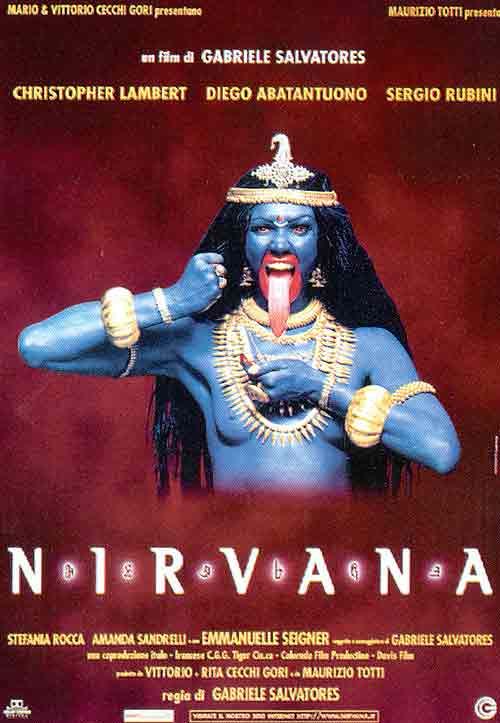
Nirvana (1997)


Title: Nirvana (1997)

Director: Gabriele Salvatores

Cast: Christopher Lambert, Diego Abatantuono, Sergio Rubini, Stefania Rocca

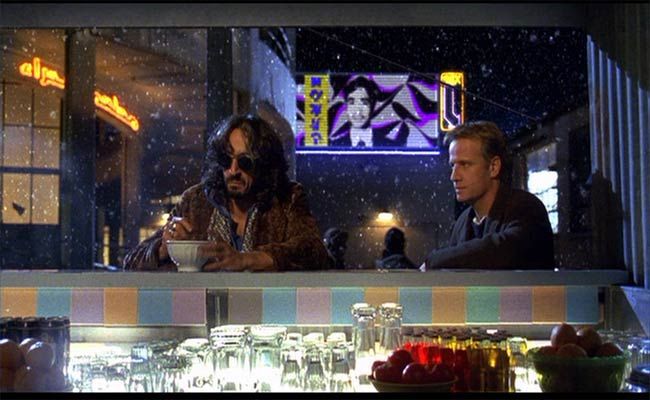
Nirvana is a film that’s trying incredibly hard to exist within William Gibson’s seminal Cyber Punk novel, Neuromancer; a novel that’s all about a futuristic world where people live only for the next cyber thrill; sometimes preferring the cyber world to the real world, in Gibson’s novel, the human race is more cyber, than human, people have implants of almost every body part imaginable. Some are willing to do anything to have their worn-out or damaged body parts replaced. So anyhow, this is the sort of picture that Gibson painted in his novel and Nirvana, the film I’ll be reviewing today, is trying very, very hard to exist in that same type of universe, a universe filled with hackers living in a bleak, futuristic world where the information super highway actually brings a sort of relief from the harsh realities of the world the characters inhabit.


In Nirvana Christopher Lambert plays Jimi, a computer programmer who is working on his latest video game called ‘Nirvana’, hence the title of the film. The game is to be released come Christmas time and Jimi is hard at work putting the finishing touches on it. Everything changes when he realizes that one of the characters in the game, a guy called ‘Solo’, becomes self aware. Solo apparently can’t take the fact that he is conscious of his own existence, so he asks Jimi to delete him. Jimi then decides to travel to the head offices of  'Okasama Star' his employer, in order to delete the game from their main system. At the same time, Jimi is trying to deal with the fact that his wife has left him and apparently doesn’t love him, so at the same time, the film is all about Jimi trying to bring closure to the relationship, or rekindle the love that was once there? It’s a film that's very cyberpunk, but at the same time deals with some very human issues.


Nirvana is an Italian film that comes to us from director Gabriele Salvatores, a director best known for having won the best foreign film Oscar in 1991 for Mediterraneo (1991). What’s interesting for me is that Salvatores doesn’t usually direct sci-fi films, his films fall more on the dramatic or comedic side, so it’s interesting to see him tackling a sci-fi film. The thing about sci-fi films is that if you don’t have the budget to create a fictional world convincingly, it always shows. In the case of Nirvana, its budgetary restraints are evident in the cramped sets and small in scope story, but you can still see that the filmmakers tried their best to offer us interesting visuals in spite of their low budget. Salvatores plays with the color palette a lot and gives the film a distinctive feel and look, I enjoyed that. Low budget sci-fi films can end up looking terrible, unfinished and half assed, but when in the hands of a skilled filmmaker, sometimes the film can end up looking better than it should’ve. 


 I love how low budget productions can force filmmakers to play with ideas and push the envelope and in that respect, I thought Nirvana did well. It has many ideas that help establish the futuristic elements.  One scene towards the end in which Jimi and Joystick are running from bad guys through the rooms of a hotel was particularly entertaining, every room they go into offering some crazy ass situation, amusing to say the least. Nirvana was made in the 90’s, when virtual reality was a fairly 'new' concept that Hollywood decided to exploit in films like Freejack (1992) and Johnny Mnemonic (1995), two films that undoubtedly influenced Nirvana because they all play around with that idea of maintaining a consciousness alive through technology. I love how many cyberpunk films involve that visual of putting a helmet over your head and just drifting away into the matrix. The thing with cyberpunk films is that they all go back to that one novel that started it all: William Gibson’s Neuromancer. In one form or another, all of these films owe a lot of what they are to Gibson’s novel. Visually speaking, Nirvana is also reminiscent of Blade Runner (1982), especially when it comes to scenes filled with over crowded streets, neon signs and lots of video billboards.


We can divide Nirvana into two different stories, on the one hand we have Jimi coping with separation anxiety and all the emotional issues that breaking up brings with it, and on the other half we have Jimi trying to infiltrate Okamasama Star’s system to delete Nirvana. Through Solo, the computer character that becomes sentient, the film goes into existential territory which I liked. It’s in these scenes that the film plays with the idea of humans questioning our existence. Why we are here and what’s the meaning of it all? I liked the character of Solo because he is an inquisitive character, representing that small part of humanity that ‘wakes up’ and starts seeing things for what they are. Another element that makes Solo an interesting character is that he speaks with his creator, Jimi. This gives Solo the opportunity to ask his creator all sorts of questions to try and make sense of his existence; essentially assigning the role of God to Jimi the game programmer, the hacker. So the film gets existential, I mean, what would you ask God if you had the chance to talk to him? Interesting part about both characters, Jimi and Solo, is that they are both looking to be at peace with the world around them and with themselves. Will they achieve it? Will they ever achieve Nirvana?


Jimi meets up with some interesting characters throughout his journey; two hackers known as Joystick and Naima. Naima is beautiful and becomes Jimi’s love interest, but Joystick is the coolest one for me, in fact, if you ask me he offers up the liveliest of the performances in the film, even surpassing Lambert, who to be honest comes off as rather bland. But the cool thing about Christopher Lambert is that he projects a naturally likability, so his characters come off as likable as well. Both Joystick and Naima, the characters that aid Jimi on his journey, seem to be taken right of of William Gibson’s Cyberpunk universe. Joystick with his electronic eyes and Naima with her brain implants. I’d say that if you’re in the mood to watch a good cyberpunk film and you don’t mind seeing a film that’s smaller in scope but big on ideas, well, Nirvana is not a bad little film to see.  My recommendation is don’t expect huge action scenes or big special effects, because this is a more personal story, smaller in scope. Also, it’s dubbed, so there’s that. Still, the cyberpunk and sci-fi elements are very strong on this one, which makes it for me a must watch for lovers of cyber punk cinema.


Rating: 3 1/2 out of 5


Friday, April 25, 2014

Freejack (1992)


Title: Freejack (1992)

Director: Geoff Murphy

Cast: Emilio Estevez, Rene Russo, Mick Jagger, Anthony Hopkins, Jonathan Banks, David Johansen, Amanda Plummer, Esai Morales

Freejack has an interesting idea behind it: rich people from the future steal bodies from the past seconds before they are about to die so that they can use these bodies to transfer their own consciousness into them and get a second chance at life, in a new body. So I guess we could say that in the future, rich people have discovered the secret to immortality. But what happens when one of these bodies resists being lobotomized and is fully aware of what’s being done to them? This is the premise for Freejack, a film based on the novel Immortality Inc. by Robert Sheckley. So yeah, interesting premise for a film, did the filmmakers pull it off well? Or is this another botched adaptation?


I haven’t read the novel, so I couldn’t tell you how well it translates from book to film, but I will say that the film has some interesting ideas behind it while still delivering some action. This is essentially a chase film, the kind of film in which characters are always running, jumping and escaping certain death. In that sense, Freejack is never a boring film. The film attempts also to infuse the proceedings with a hint of comedy, by this I don’t mean that it is ‘hardy har har funny’ but it certainly does have its fare share of one liners. Emilio Estevez plays Alex Furlong, the man on the run. While watching this film I couldn’t help and compare it a bit to Paul Verhoeven’s Total Recall (1989), which in my opinion is the film that Freejack is trying to imitate, at least in tone. The problem is that nobody could imitate Paul Verhoeven’s acidic sense of humor and so Freejack just comes off as goofy, primarily because its leading man doesn’t seem to be taking things too seriously, he seems to be having a good old time with all these people chasing him and cars exploding around him. The film has this uneven tone to it, is it funny? Is it serious? I guess the only guy to blame for this would be Geoff Murphy, the films director.


I don’t know whose idea it was to put Emilio Estevez in the starring role, but in my book he just doesn’t pull of a convincing leading man, he looks like somebody who’s just goofing around the set rather than somebody who is running for his life. I guess the only reason Emilio Estevez is on this movie is because he’d worked before with Geoff Murphy on Young Guns II (1990). But I could definitely see somebody else on the title role, somebody with a little more ‘gravitas’, cause Estevez just doesn’t have them. In terms of supporting actors the film is solid; we get Anthony Hopkins, Rene Russo and we even get Mick Jagger as a lackey and New York Dolls front man David Johansen in a small role. But with such a solid cast, where Freejack failed was in choosing Estevez as the leading man. He seems more suited for a silly comedy like Loaded Weapon 1 (1993) than a science fiction film like this one.


The good thing about Freejack is that it has plenty of action sequences, the only problem is that it suffers from what a lot of action films from the 80’s suffered from: the chase sequences feel like a check list of every car stunt known to man. So you're like 'oh they're doing the car flipping over and exploding trick', they definetly have a been there done that feel to them at times. Now imagine that with Emilio Estevez pulling a one liner every time a car explodes and you get the jist of the kind of action sequences you can expect from Freejack. Still, some of the car stunts are pretty cool, however unbelievable.


On the cyberpunk side of things we get the dilapidated society, with rich people living in luxury and the poor living extreme poverty. We get the element of transferring human consciousness into a computer and then using modern technology to transfer a consciousness into a new human body. So there’s that common element seen in many Cyberpunk films of the ‘ghost in the machine’, an idea that was recently seen in Transcendence (2014) and also in Johnny Mnemonic (1994). Cool part about this whole ghost in the machine business is that it lends itself for some cool computer graphics and compositions which might feel a bit dated, but I’ll be honest, still look pretty cool by today’s standards. We also get that idea that big corporations have taken over the world, which is a staple of cyberpunk cinema, the big company is the big bad guy.


Another fault the film has is that cars that are supposed to look ‘futuristic’ , don’t. This is something that so many low to medium budget sci-fi films suffer from, the cheap or clunky looking cars. Last time I remember seeing it was on Equilibrium (2002). The problem is that they convert existing cars by adding a couple of panels and a coat of paint. Then voila!, they call them futuristic, but god, on this one it’s so blatantly obvious that they are not. Not to the director: painting a military vehicle red does not make it futuristic! So yeah, you get these clunky looking cars, which are not cool. These are the times when I miss Syd Mead or Jean Giraud doing the conceptual designs. Conceptual designs are so important in a science fiction film, if you don’t pay attention to conceptual design, where the artist designs elements from the film to make them look functional and cool at the same time, well, you get the clunkiness. I mean, look at the cars in freaking Blade Runner! The freaking Spinners are so awesome! I wanted a Spinner! But I do not want any of the cars in Freejack. In the end, Freejack is a fun, fast paced films that has a couple of hiccups along the way but is still a fun watch in my book. I like those scenes with Emilio Estevez and Anthony Hopkins battling for their respective minds! Just don’t expect a masterpiece and you’ll be fine, this one is a glorified b-movie all the way!

Rating: 3 out of 5 


Thursday, August 22, 2013

Elysium (2013)


Title: Elysium (2013)

Director: Neil Blomkamp

Cast: Matt Damon, Jodie Foster, William Fichtner, Alice Braga, Sharlto Copley, Diego Luna, Wagner Moura

Elysium comes to us from director Neil Blomkamp, the guy behind the critically acclaimed box office hit District 9 (2009), a fantastic film in my book because it speaks about racial differences and the need for different races to show empathy towards one another. In that film, aliens arrive on earth and are initially welcomed by humanity, but after a few years, that welcome wears off and transforms to xenophobia. It isn’t long before the aliens are segregated and end up living in these refugee camps that have turned into ghettos. The main character of the film is a human immigration officer named Wikus, a man who has been appointed the task of giving the aliens eviction notices that let them know they are now being relocated. One thing leads to another and Wikus ends up turning into an alien. He quickly learns what it means to be persecuted, he feels the unfair treatment; he gets to understand what being on the other side is all about. Blomkamp figures that the best way to know what racism feels like is by experiencing it yourself, which is what is so brilliant about District 9, you feel racism first hand, you feel it’s happening to you. Racism is something humanity has yet to outgrow; Blomkamp knows it and wants you to experience it. On Disctrict 9 the main character is part of an oppressing force in society, but then he becomes the oppressed, he becomes the one that’s persecuted, he suddenly knows what it means to be on the other side of the equation. And that was just Blomkamp’s first film! District 9 made such an impact that the film was nominated for four academy awards including Best Picture and Best Adapted Screenplay, something of a rarity for science fiction films. So of course he was going to move up in the film world, of course we were going to see another film by him. So here comes Elysium, Blomkamp’s sophomore effort, his second film. How was it?


On Elysium the world as we know it has gone to shit, essentially, earth is one giant dumpster, the poor live down here on earth, while the rich and privileged live on a gigantic spaceship hovering close to earth called ‘Elysium’. The story revolves around Max, a blue collar worker who ends up having a horrible work related accident and is suddenly faced with the fact that he only has five days to live! What can he do in order to survive? Well, if you were rich and lived on Elysium you’d simply get inside something called a ‘Med-Pod’ and cure yourself, but that’s only if you live in Elysium, if not, then you die because you are not one of the privileged, you my friend are scum. But what if there was a way to make these machines available to everyone? What if someone could infiltrate Elysium, reboot the whole system so that everyone can benefit from these Med-pod’s? This becomes Max’s mission, for he is not about to die any time soon!


First thing I noticed right away was how similar Elysium is to District 9 in terms of themes. This film is also about one group of people being neglected and oppressed by others. The whole thing with the rebels trying to get into Elysium felt a heck of a lot like Mexicans trying to cross the American border, so in that sense, it is also felt like it was addressing racial issues. The difference between both films is that while District 9 presented us with themes of xenophobia and racism, Elysium focuses more on themes of classism. But then again, class issues and racial issues function in the same ways, so yeah, the films are very similar in this way. We’re basically talking about one group of humans thinking they are superior to another which is kind of disgusting because we’re all humans on this spaceship called earth, so what’s the point? Why do some humans feel the need to bring others down? I personally find the idea repulsive and nauseating, as should every one of you out there my friends. We should aim to help each other, not exploit each other. So I immediately found the themes in Elysium fascinating because they speak of the world we live in today. After the success of Elysium, Blomkamp said that he’s been asked about how he sees the future, how he thinks the world will be and his answer was that the film isn’t so much about the future, that it’s about the world as it is NOW, which is a fantastic reply. This lets us know that Elysium is the best kind of sci-fi, it’s the kind that reflects society, it holds a mirror to it.


I mean, wouldn’t it be better if those that achieved success and wealth in the world used that power for the good of all humanity as opposed to propelling a society that is built on the idea of exploiting those less fortunate? This is what happens in the world today, and it’s just another form of slavery if you ask me. We don’t have people putting literal chains on others, but there’s symbolic chains, you know what I mean? The way society is constructed benefits the wealthy and ignores the poor. One of example of this are the roads in my country of Puerto Rico. You go into a rich neighborhood and you see the streets paved, the street lights illuminating every street corner, the garbage picked up, but if you go into a poor neighborhood you see streets filled with gigantic holes (because the government doesn’t pave them) you see dark streets because light posts are shut off and the streets filled with garbage because the government doesn’t bother picking up the garbage on a regular basis. So yeah, there’s a difference in the way classes are treated. Wouldn’t it be better if everyone was treated fairly? I’m talking about my country here, but I’m sure this is the same in many countries; the poor side is ignored and treated unfairly, this is why ghetto’s exist. It’s a place to dump the poor so they don’t have to live next to you.  Sad part is all those poor people pay taxes as well; their money should pay for the cleaning up of their town as well. It should be enough to light all the streets and avoid dark areas that breed criminal activity. But alas, this is the world we live in and these are the lives were living.


And so, the same can be said of medical attention, which is a major issue in Elysium. On the film the Med-Pods are these miracle machines that can cure any decease, hell, they can even bring you back to life! According to the film, you can live forever if you are a citizen of Elysium! This part of the film talks about expensive medical plans that many people cannot afford to pay and the ridiculously high priced medicines. Ever had to take a pill that costs more than 70 dollars? I know people who have. Many can’t even afford paying a medical plan; they live life frightened of getting sick or needing major medical attention. Shouldn’t medical plans be more affordable? So the situations depicted in Elysium aren’t farfetched at all, only the wealthy get the best medical attention, the poor get the worst or none at all. The poor get sick and die faster. Why are things this way? Maybe this is the kind of situation that the powerful want? For poor people to die faster? Things to think about, and so, this is the main theme of Elysium, making quality medical attention affordable to everyone! How hard can it be? The same can be applied to education which is also kept expensive so only a certain group of people can get quality higher education, this is a vicious circle from which only the wealthy can benefit from .


Visually speaking the film is impressive, I mean, Elysium itself is a wonderful creation. It’s this gigantic spaceship/city hovering in space. By the way, this idea of a giant spaceship that harbors livable space inside of it reminded me a lot of Arthur C. Clarke’s amazing novel Rendezvous with Rama.  Anybody read that one? It’s one of my favorites of Clarke’s and basically, it’s about this gigantic spaceship that one day parks itself next to earth. The government then organizes a search party to enter it. They discover that inside of the ship there is a habitat, including a city, an ocean, artificial sunlight and plants…basically the same idea we see in Elysium. I’m thinking Blomkamp maybe read Randezvouz with Rama and was a bit inspired by it. Though the idea of spaceships with habitats inside of them is nothing new, I mean, this premise was also explored in Disney’s The Black Hole (1979), only in a far cheesier fashion. These similarities with Clarke’s novel got me thinking that Blomkamp would be the perfect director for a Rendezvous with Rama adaptation. By the way, Elysium also has elements from George Orwell’s 1984, and George Lucas’s THX-1138 (1971), especially when it comes to the whole thing with Max working in a robot factory, and the whole thing with the robotic police force. It also shares similarities with Johnny Mnemonic (1995).


An amazing cast brings this one to life, Matt Damon is great as Max, he pumped up for the part and looks like a tank for it. Jodie Foster is effectively icy as Delacourt, the person in charge of running Elysium. She's a nice lady to her rich costumers, the people of Elysium, but an icy cold bitch to those who want to try and enter into her special private little kingdom, kind of like the governments of the world who only cater to the wealthy. Sharlto Copley, the actor who played Wikus on District 9 reunites with Blomkamp once again. He plays Kruger, a killer/mercenary that the government hires to execute Max, interesting how the film alludes to the idea that governments sometimes rely on the help of criminals to achieve their goals. Copley really gives it his all here, dare I say he actually kind of outshines every other actor in the film.  I was also glad to see Diego Luna on this show, though he has a small part. So anyways, I’ve gone on long enough about Elysium, it’s a fantastic sci-fi film, the best kind, the kind that talks about the world we live in through its fiction. The success of the film has probably assured Blomkamp’s next film which will be called Chappie, looking forward to it. I’m happy that Blomkamp has rejected working on established science fiction properties like Star Trek or Star Wars (yup he’s gone down saying that) in order to stick to his more original stuff. What a fantastic concept, a director aiming to do something new and original, how about that?


Rating:  5 out of 5 


LinkWithin

Related Posts with Thumbnails